Avalanches and Avalanche Prevention
Avalanche structure in Neskaupsstaður

Or try searching by Category and/or Location
Avalanches are magnificent natural events but also terrifying and dangerous. People have lived with the threat of avalanches in many places in Iceland for centuries, especially in coastal areas where there is heavy precipitation, steep mountains, and little lowland to build on. In these areas, towns have developed around fishing, as the steep mountains and deep fjords also provide deep waters and good natural harbours.
Although the knowledge about avalanche danger has been long-standing, it was not until after two fatal avalanches in the Westfjords in 1995 that systematic avalanche prevention began. Protection may involve moving properties and infrastructure to safe places or protecting them where they are. In a country where nature is often harsh, like Iceland, preparedness against natural hazards is a normal part of living and utilizing its nature.
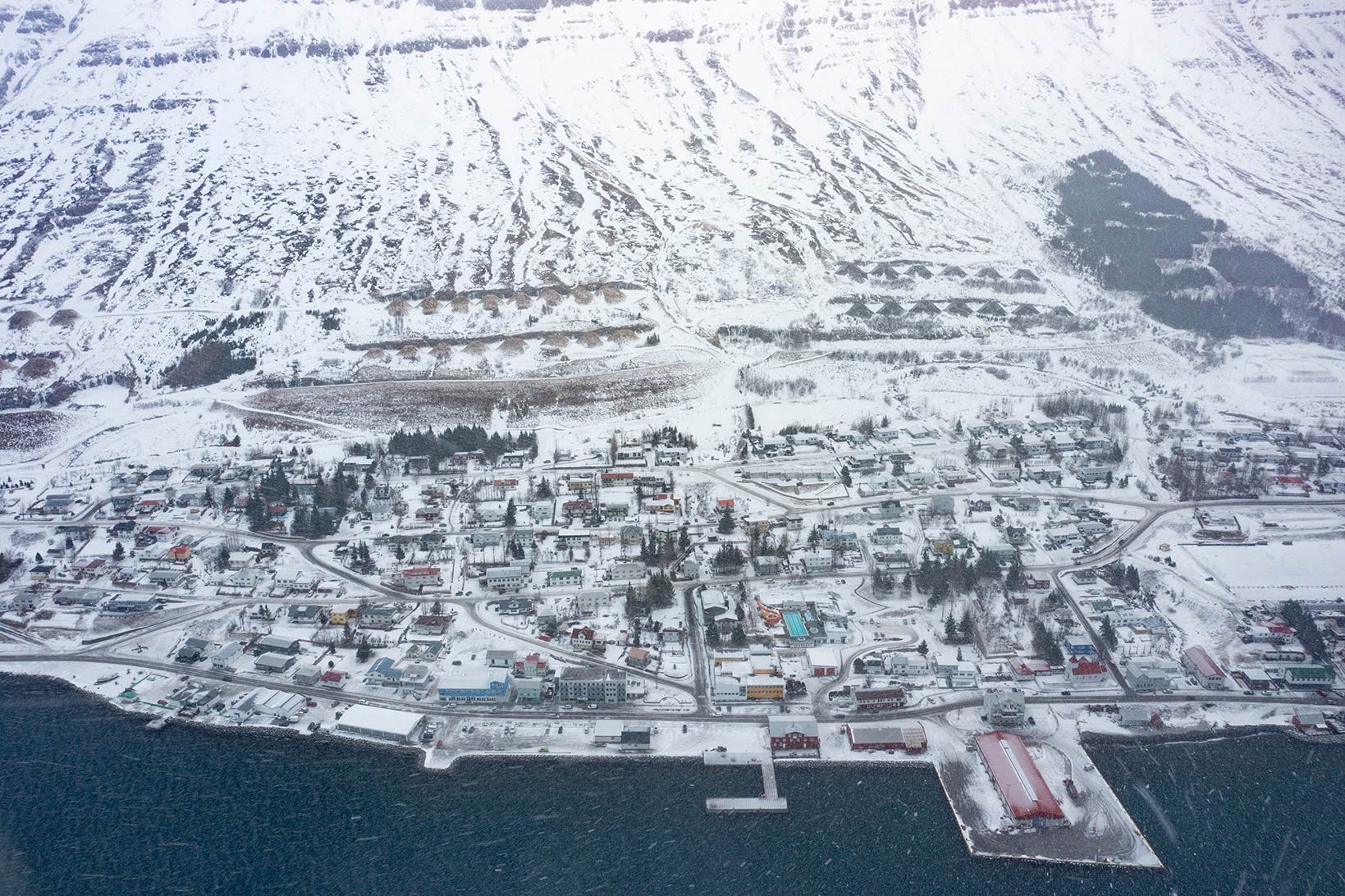 Avalanche barriers and structure in Neskaupsstaður. Photo: Michael Novotny
Hiking Trails by the Avalanche Barriers in Neskaupstaður
Above the settlement in Neskaupstaður are some of the most extensive avalanche structures in Iceland, and a significant network of hiking trails has been developed around the barriers above the town, allowing for both short and long hikes. There are beautiful views over Norðfjörður and the countryside from the barriers and various hiking trails. It is also ideal for runners who enjoy varied but peaceful routes with challenging slopes. The area between the barriers and cones is sheltered, with berry picking spots, forestry areas with birds like the goldcrest, Europe's smallest bird, which has settled there. You can continue through the forest or below it along a good path above the settlement to Norðfjarðarviti lighthouse and from there to Easter Cave and other places in the Neskaupstaður Nature Reserve.
Above the barrier is also the start of a marked trail over Miðstrandarskarð to Mjóifjörður. The best place to start the journey is at the entrance to the town, by the memorial for those who died in avalanches in the area, or at the campsite above the town, but you can also start from the parking lot by Norðfjarðarviti lighthouse.
When moving around the area, one can imagine the scene when avalanches fall from the many gullies and basins in the mountainside: the roar, the snowstorm, the pressure wave, and the forces at work as tens or hundreds of tons of snow are hurled down the mountain and how the barriers serve their purpose.
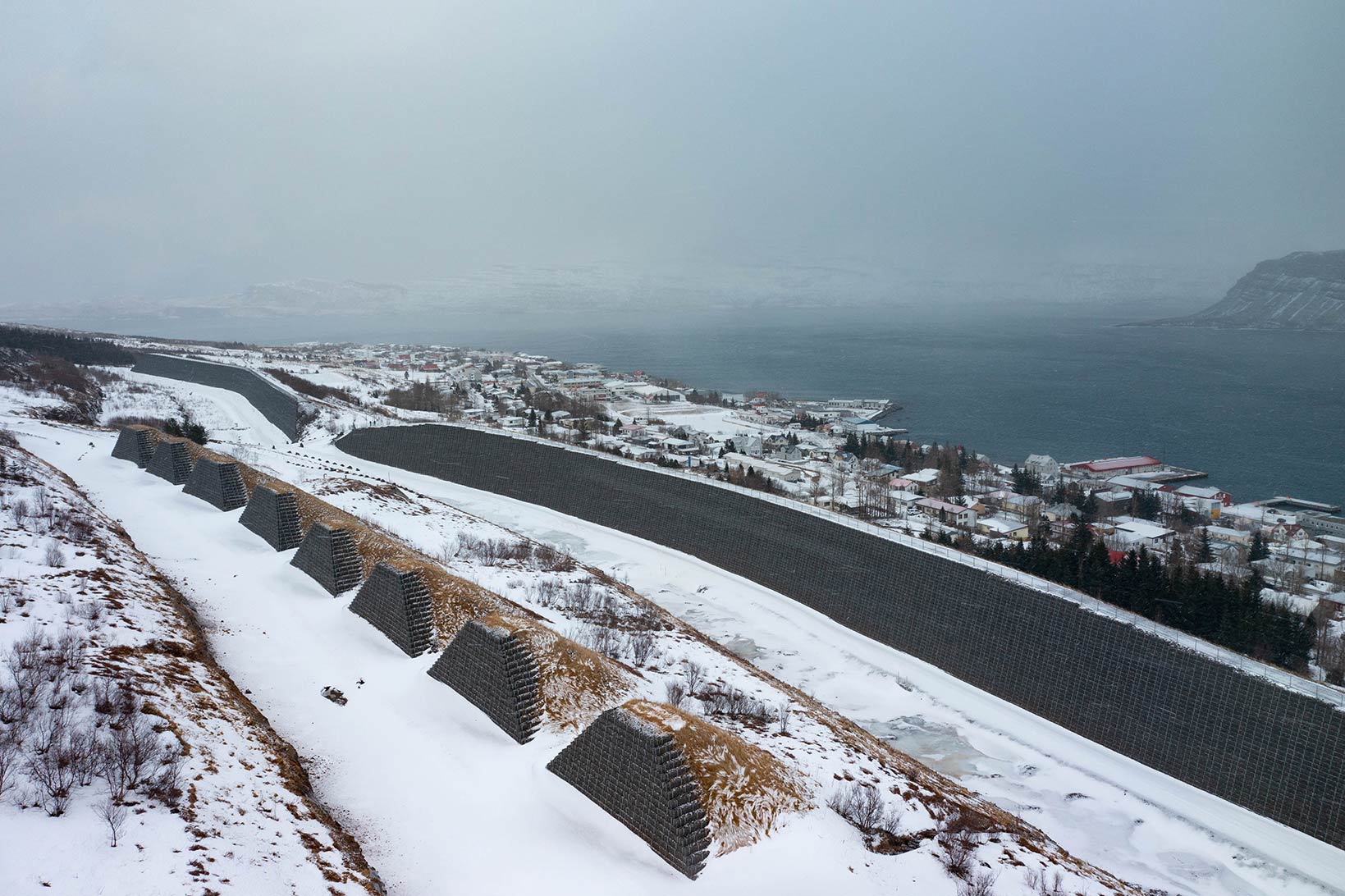 Avalanche structure in Neskaupsstaður. Photo: Michael Novotny
The history of avalanches in Neskaupstaður shows that avalanches have often fallen from the mountain above the town, usually near areas that are now built-up. In December 1974, deadly avalanches occurred, killing 12 people, and in March 2023, avalanches fell on residential houses causing significant damage, though people narrowly escaped. The first avalanche structures in Neskaupstaður were built between 1999-2002. A large system of barriers and cone areas has been constructed just above the settlement, and further up the slopes are starting support structures consisting of nets and grids, but some parts of the town are still unprotected.
In Neskaupstaður, avalanche danger affects the upper part of the town along almost its entire 2.5 km length. At the top of the steep slope, there are many gullies and basins that can accumulate large amounts of snow, which can easily start to slide, and the gap between the built-up area and the steep mountainside is short. Designing and implementing avalanche protection in such an area is complex because the space for avalanche barriers and cones is the strip between the settlement and the steep mountainside. It is not possible to use guiding barriers to direct avalanches away due to the long continuous area. Instead, protections must aim to stop avalanches above the settlement and reduce the likelihood of avalanches starting.
Avalanche structures are not very noticeable from below, but when walking around the area or standing on the barriers and above the cone area, the scale of these structures becomes apparent. Four barriers have been built: three transverse barriers and one guiding barrier at the inner end of the settlement. The construction of a fourth transverse barrier east of the existing ones is planned. Above all the transverse barriers are rows of cones, and further up in the mountain, in the gullies and basins that accumulate snow, there are either grids or nets. The side of the barriers facing the mountain from where the avalanches come is very steep, usually 17-20 meters high. The side facing the settlement is rounded and does not rise as high above the ground. Above each barrier are two rows of cones, a total of 52 cones, each about 10 meters high. Grids and fences in the starting zones of avalanches high up in the mountainside aim to bind snow and prevent snow slabs from starting or at least reduce the amount of snow that slides down if an avalanche occurs.
The transverse barriers are intended to stop avalanches, and behind them, a gully or depression is dug to increase the height on the side of the barrier that the avalanche hits, to accommodate more snow above the barrier, and to limit how high the barriers rise above the settlement. The wall of the barriers facing the mountainside is almost vertical to increase the chances of stopping the avalanches. Cones are placed above the transverse barriers in two rows. The cones have the same profile as the transverse barriers, rounded on the side facing the settlement but vertical against the mountainside. The purpose is for the cones to absorb the force of an avalanche that hits them before the avalanche then reaches the barrier and stops there. When the avalanche hits the vertical side of a cone in the upper row, it is thrown up over the cone and lands above the next row of cones. If the avalanche still has enough force to continue, this process repeats at the lower row of cones, and the avalanche is thrown over it too and lands above the transverse barrier, in the gully there, and stops. This design is based on research and collaboration between scientists and structure designers both in Iceland and abroad, such as in France, Austria, Switzerland, and Norway. When an avalanche hit the avalanche structures in Neskaupstaður in March 2023, the interaction between the cones and the transverse barrier worked as intended. This was confirmed by a video captured of the event and the traces left in the avalanche area. It is the first time this interaction of cones and a transverse barrier has been confirmed in Iceland.
Route to Brún in Bjólfur
You can hike, run, or drive a four-wheel-drive vehicle in the summer from highway 93 through Stafdalur to Bæjarbrún/Brún, where avalanche barriers have been erected over part of the settlement in Seyðisfjörður. The route is beautiful, with steep mountainsides, rocks, moss-covered hollows, streams, and rivers. There are no views of the fjord or the town until you reach Brún. Up there, there is a danger of avalanches in winter, so caution should be taken in winter trips. On a good summer day, one can imagine the scene when avalanches cascade down the slopes of Mt. Bjólfur.
When you reach Brún, there is an exceptional view over Seyðisfjörður, from the fjord's mouth and the surrounding mountains. Special viewing spots have been created by the avalanche barrier, offering a magnificent view over the fjord and town, almost like a bird's-eye view. Above, the peaks of Bjólfur tower over the fjord. A competition was held for an impressive viewing platform on Brún following the construction of the avalanche barriers and the creation of access roads. The chosen design was "Ring of Bjólfur" a circular viewing platform that will be built south of the avalanche barriers on Brún. The ring shape is meant to blend uniquely with the landscape, offering a floating and unique experience beyond what can be seen from the mountain's edge.
The Story of Bjólfur and the Mountain
The story goes that the mountain is named after Bjólfur, who settled in Seyðisfjörður, and that his farm stood at the foot of the mountain. It is said that Bjólfur, the settler, was buried in the mountain ridge above his farm where he lived, and there you can see a mound to this day. In ancient times, people were often buried with various valuable items, known as grave goods, which they chose to take with them, such as favourite weapons and jewellery. Nothing is known about whether and what grave goods Bjólfur had with him in the mound, but it is not impossible that there was a magnificent silver ring. From Baugur, it is a short distance to the avalanche barriers. You can continue north over the mountain down to Vestdalur and then follow the marked path down to Seyðisfjörður or head west past Vestdalsvatn down Gilsárdalur to Gilsárteigur in Fljótsdalshérað.
The deadliest avalanche in an urban area in Iceland fell on the settlement below Bjólfur in Seyðisfjörður in February 1885 where 24 people lost their lives. Since then, there have been no fatal accidents caused by avalanches in the fjord, though there have been some close calls. It wasn't until about 110 years later, following deadly avalanches in Súðavík and Flateyri in the Westfjords in 1995, that systematic efforts to prepare avalanche defenses for Seyðisfjörður began.
Bjólfur is one of the majestic mountains of Seyðisfjörður, standing 1085 meters tall. Its lower slopes are fairly uniform, with most gullies being rather shallow and the cliff belt stretching along the entire slope. Above the settlement beneath Bjólfur at about 650 meters in height, lies Bæjarbrún or Brún. Above Brún, the mountain features a plateau shaped by hills and ridges, and above that, there are large avalanche starting zones between 700 and 950 meters above sea level, where avalanches are frequent. Significant snow accumulation occurs in these starting zones and on the plateau. To address this, avalanche barriers were built on Brún between 2003 and 2005, consisting of a guiding barrier and a transverse barrier. These barriers are designed to stop avalanches from Bjólfur. However, it was clear that they were not a complete solution, and additional defenses were needed on the slope below.
Construction of these barriers began in 2021 and is expected to be completed by 2025. The construction includes guiding barriers on either side of the neighbourhoods below Bjólfur. The design of the guiding barriers and the transverse barrier aims for the highest possible barriers that could be placed between the steep slope and the settlement, with the purpose of directing avalanches past the settlement to the sea or down to undeveloped flatland.