Hengifoss and Litlanesfoss waterfalls
Hengifoss

Or try searching by Category and/or Location
Hengifoss waterfall in Fljótsdalur is one of the best-known destinations in East Iceland. It is the third highest waterfall in the country, majestically standing at about 128 meters high. The Hengifoss River boasts a beautiful series of waterfalls, with Hengifoss being the most prominent. The brink of the waterfall is about 450 meters high in the hillside, and it stands out against the sky from the valley below. The waterfall plunges into a dramatic but beautiful gorge that forms a large bowl in the hillside. The gorge walls are basalt columns with notable red layers between the basalt layers. Beneath the waterfall are thick sedimentary layers formed 5 to 6 million years ago. At the top of these layers is lignite, remnants of a large forest, where pieces of tree trunks and roots are occasionally visible, pressed together by the weight of the earth. Basalt lava flowed over the forest in this depression, and sedimentary layers later settled on top of it. Two streams, both named Sellækur, flow in waterfalls and rapids down into the gorge. In the gorge are large and picturesque piles of rocks that have broken off from the sedimentary layers.
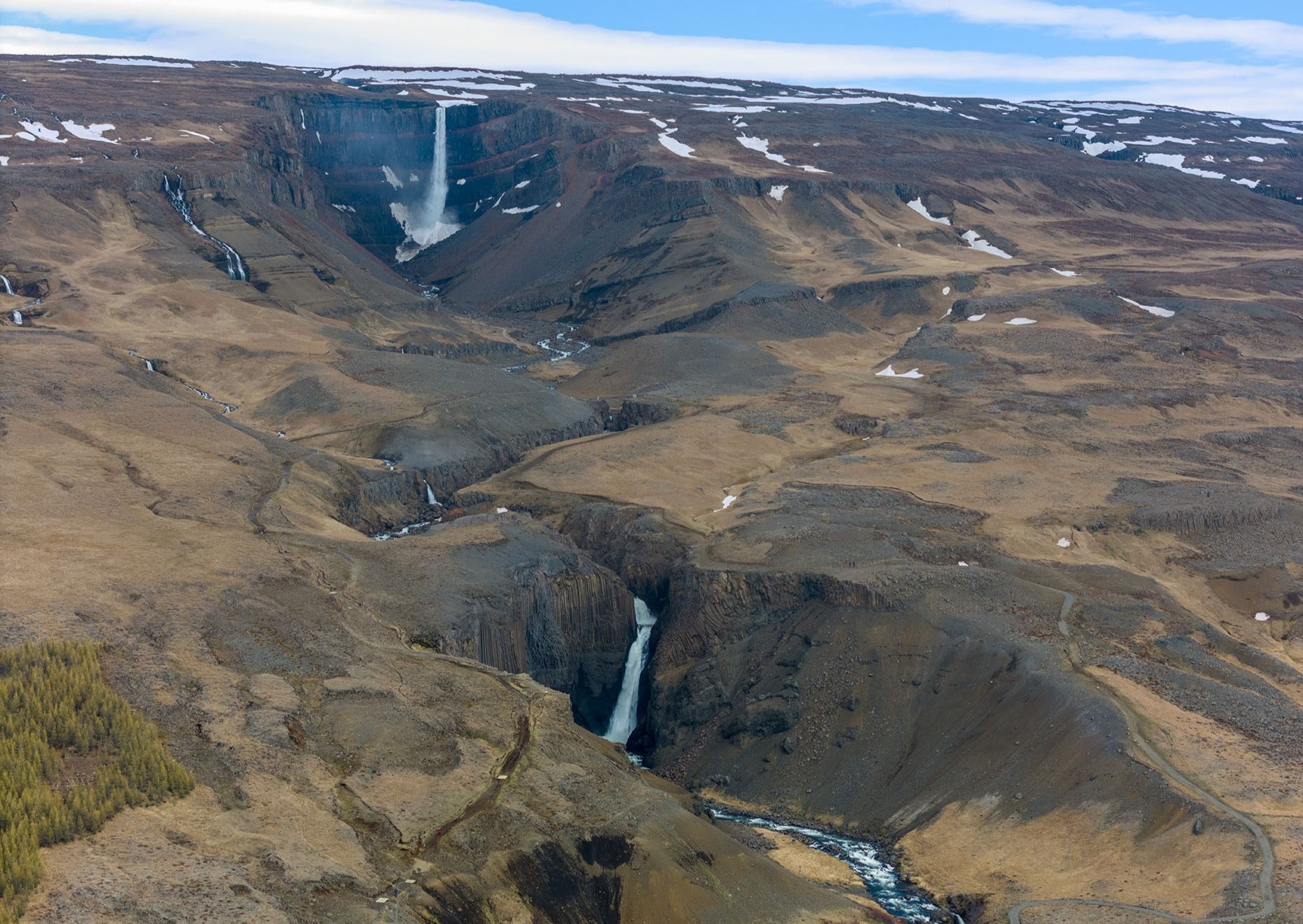 Hengifoss and Litlanesfoss waterfalls. Photo: Michael Neumann
Litlanesfoss is located halfway up the hillside, roughly midway to Hengifoss. It is not particularly tall, about 25-30 meters, but it is surrounded by an exceptionally beautiful columnar basalt formation with unusually tall columns. It has been compared to a wide, tall choir, with the straight columns reminiscent of the pipes of an organ. Below Litlanesfoss is also a series of sedimentary layers.
There are several smaller waterfalls and rapids in the Hengifoss River, including two beautiful waterfalls above Hengifoss that are not visible from below. The river gorge from the road up to Hengifoss is covered with birch and rowan trees. Lower in the gorge, on the outer side, is Skógarhvammur, a hollow surrounded by cliffs. At the mouth of the gorge are the remnants of the Hengifossá corral, which was used for sheep gathering until around 1900.
From Egilsstaðir, you can drive through Hallormsstaðaskógur (route no. 95 to Grímsá and then to route no. 931) or through Fellabær on the north side of Lagarfljót (route no. 931). The distance to Hengifoss is similar whichever route you choose, making it ideal to take the circular route, the so-called Ring of Riverdale, which includes many interesting destinations.
From the parking lot at Hengifoss, well-marked hiking trails lead up to the waterfall on both sides of the river. It takes about 40-60 minutes to walk all the way up, and the total distance is about 5 km round trip. Starting directly from the parking lot, there are first steps, then a gravel path, and in some places mats or platforms.
On the way, you pass Litlanesfoss with its unique columnar basalt formation. You can detour on either side of the river and down into the gorge where Litlanesfoss falls, but caution is required near the edge of the gorge, which is steep and can be slippery, and by the river.
The hiking trails mostly run through vegetated slopes along the edge of the gorge. You can find heather and various moorland plants, with harebell, one of the characteristic plants of East Iceland, being common there, as well as a lot of bedstraw, which is otherwise rare in East Iceland. It’s good to take your time to stop and appreciate the river gorge, the vegetation, the landscape, and the view over Fljótsdalur and the surrounding mountains.
Higher up on the trail is an information sign with a good view of the waterfall and the gorge. You can hike into the gorge itself and all the way to the waterfall, but care is needed as the path is rough and can be wet, so good footwear is essential. During winter, hikers should prepare well for the trip, checking the weather forecast and conditions before setting out. Crampons may be necessary as ice patches can be dangerous. Rockfalls can also occur when entering the gorge.
Standing inside the gorge and hearing the waterfall echoing off the cliff walls is a unique experience. When there is little water flow in the waterfall, it is possible to walk behind it into a small cave. You can take the same path back, but it offers a different perspective to cross the river on the footbridge in the gorge and walk down the other side. At the bottom, there is another footbridge back to the parking lot.
The hiking trail to Hengifoss is open year-round. During the summer, rangers provide information about the area and guidance up to the waterfall. There is a parking lot by the highway near Hengifossá, with information signs and a service building at the parking lot.