Stone Collections in East Iceland
Auðunn´s stone collection in Djúpivogur

Or try searching by Category and/or Location
Stone collecting is an exciting and rewarding hobby, full of adventures, learning, and experiences of nature's wonders and beauty. Stones have diverse shapes, colours, textures, and patterns that captivate; for example, children often have a keen interest in stones. For those who engage in it, stone collecting becomes a passion. Some argue that subconsciously, we are drawn to stones in the same way we are attracted to open fire. It is often said that stones emit energy, and in folklore, stones were even believed to possess hidden properties, such as magical stones like cloak of invisibility stones and wish stones. The East Fjords have long been known as places to find beautiful and diverse stones, but rich stone sites are also found elsewhere in the country, such as in the West and North of Iceland. In addition to museums open to the public, there are beautiful and interesting private stone collections in East Iceland.
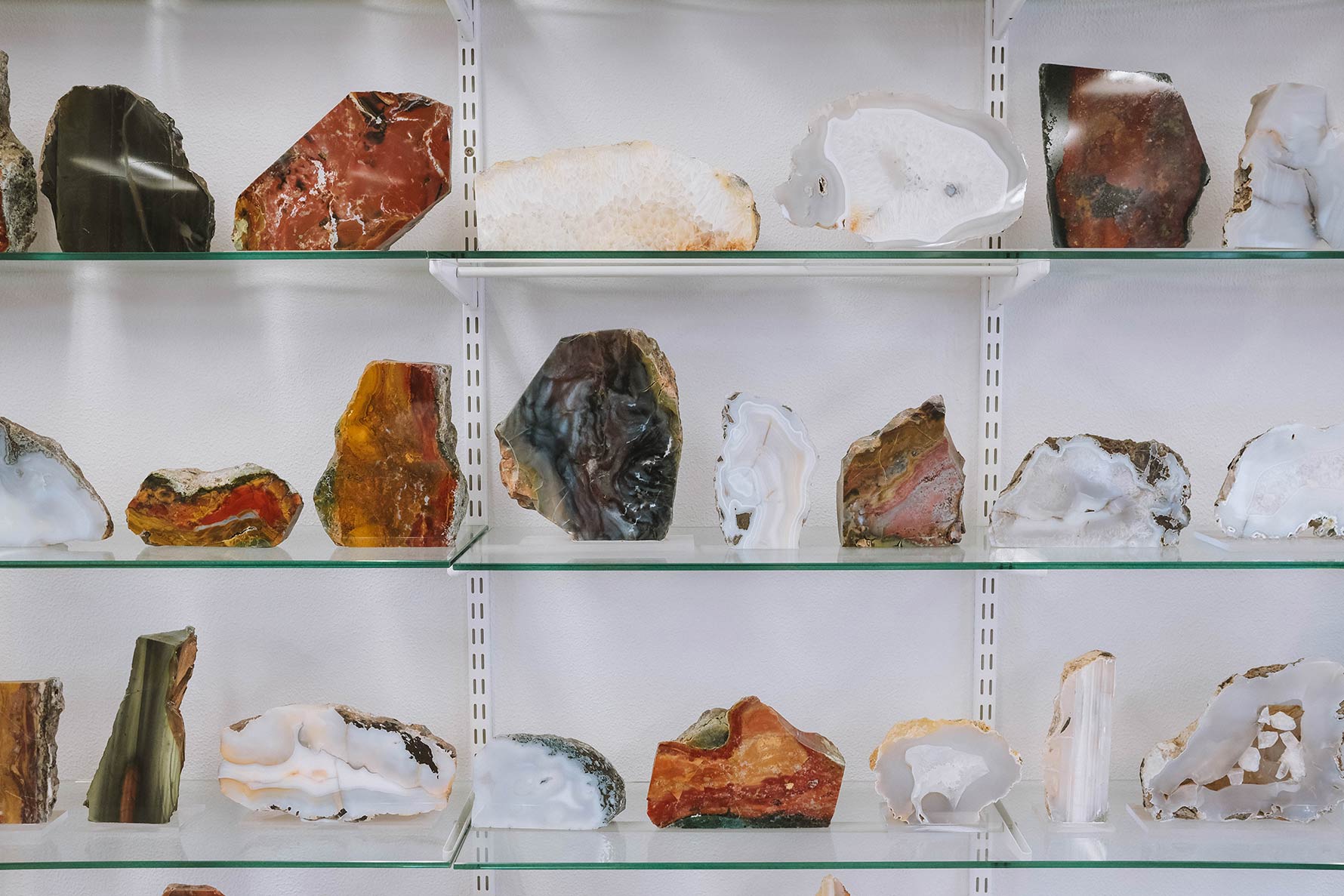 Stone collection in Djúpivogur. Photo: Michael Novotny
The Earth's crust is composed of rock, and the most common type of rock is igneous rock, which is the primordial rock from which other rock types are formed. Igneous rock forms when magma from the Earth's mantle solidifies, such as when lava surfaces. About 90% of solid rock in Iceland is igneous rock, with basalt being the most common type. Rocks are composed of minerals, which are crystalline elements or compounds found in nature and are the smallest units of rock types. Minerals are divided into two categories: primary and secondary minerals. Primary minerals form during the rapid solidification of magma and are typical of volcanic rocks. Secondary minerals form later through the alteration of rock and primary minerals due to heat and pressure or from the precipitation of substances from a solution. Secondary minerals that grow undisturbed and cool slowly often become large and beautifully shaped cavity fillings (crystals). Beautiful stones sought by collectors are usually secondary minerals. More than 4,000 mineral species are known worldwide. In Iceland, over 300 species have been found.
To understand how secondary minerals form and where beautiful stones are likely to be found in Iceland, one can look at the geological history of Iceland. About 50-60 million years ago, during the Tertiary period, the North Atlantic began to open as the tectonic plates of America and Europe started to drift apart, a process that continues today. Along the plate boundaries or rift zone, basalt emerges from the Earth's mantle and the plates drift apart. Iceland itself began to form around 44-26 million years ago with volcanic activity in the rift zone between the plates. The oldest rocks in the country date back to the Tertiary period, and the lava layers in the West Fjords, East Fjords, Northwest Iceland, and West Iceland are mostly from that period. Plate movements cause lava from eruptions in the active volcanic zone to move steadily away from the centre of the country from the rift zone. At the same time, newer lava continuously surfaces during eruptions and flows over the older layers, pressing them down, which explains why the lava layers in mountains like those in East Iceland tilt inward. Modern active volcanic zones include the rift zone from Reykjanes to Vatnajökull and north into the sea, as well as three active volcanic belts outside the rift zone: the Snæfellsnes volcanic belt, the eastern volcanic belt (from Vatnajökull south to the Westman Islands), and the Öræfajökull-Snæfell volcanic belt.
Fresh rock layers near the surface are usually porous with holes and cracks. Below the groundwater surface, all cavities and fissures are saturated with water. Deeper down, the rock spaces compress, and the Earth's internal heat starts to have an effect. The heat source is magma, and the temperature increases the deeper into the Earth you go. The hot water flowing through the cavities in the bedrock dissolves various minerals from the rock, and when the rock cools, the minerals precipitate out and form crystals. If there are holes and cracks in the rock, the crystals grow there and form cavity fillings (zeolites). If the entire rock breaks down from heat and pressure and transforms into new minerals, the rock is said to have undergone metamorphism. When the Earth's crust moves away from the rift zone and cools, deposits remain in the rock, forming various minerals, cavity and fissure fillings, and other alterations. Cavity fillings or zeolites, along with spar (calcite), are Iceland's most famous decorative stones. Spar was mined and exported, playing a significant role in the development of science and technology in the 19th century. The most famous spar mine is Helgustaðanáma near Reyðarfjörður.
During the Tertiary period, when Iceland began to form, lavas accumulated around volcanic systems similar to what happens in active volcanic areas today. Then came the Ice Age, and the Ice Age glacier carved out valleys and fjords that reach far below the original surface of the lava stacks, with the most erosion towards the coasts, as in the East Fjords, where carved mountain ranges remain separated by deep fjords and valleys. Therefore, East Iceland has many diverse and beautiful stones because the beauty and diversity of cavity and fissure fillings generally increase deeper into the geological strata. British geologist George Walker conducted geological research in East Iceland, studying cavity fillings. He identified species and found that they vary by rock type and form nearly horizontal belts in the mountains. The activities of the Breiðdalssetur center in Breiðdalsvík are largely related to the geology of East Iceland, including extensive information about George Walker's research and a scientific collection of rock cores from Icelandic geological layers.
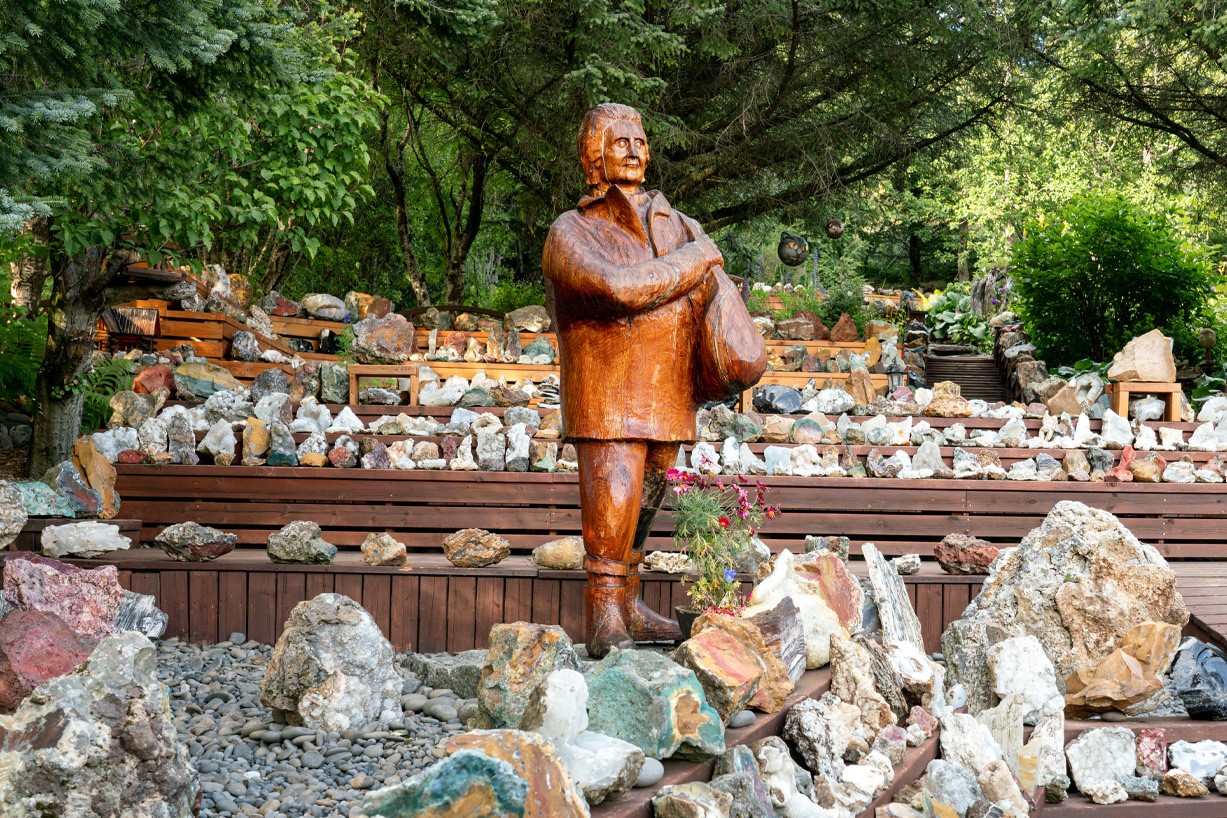
Petra´s Stone Collection in Stöðvarfjörður. Photo: Jessica Auer
Petra's Stone Collection in Stöðvarfjörður is housed in a small single-family home that was Petra's home and the surrounding garden. It is a unique museum in many ways and a remarkable experience to visit. It is even more impressive knowing that this magnificent collection is the work of one woman.
The museum is a wonderland of colours and shapes among the countless stones, without being overwhelming despite the small spaces. Stones are displayed in cabinets and shelves inside the house, and outside, stones are found throughout the garden, in beds, on terraces, walls, and shelves. There are whole stones as they appear in nature, polished stones, and stones that have been opened to better reveal their structure and inner beauty. Inside, the stones are generally sorted into major categories of the stone kingdom, with cabinets labelled. This way, visitors can learn and educate themselves about stones at the museum, and among the shelves and cabinets are signs with interesting facts and information about stones and the origin of the collection. Outside in the garden, there are also various pieces of information, and in a small garden house, Petra's story is told. Visitors can spend a long time at the museum, both inside and outside, and return again and again to see something new each time.
Petra, whose full name was Ljósbjörg Petra María Sveinsdóttir, was born in 1922 and passed away in 2012. Her home and life were in Stöðvarfjörður, where she was born and lived with her family. Her husband was a fisherman most of the time, and they had four children. Petra worked in fish processing and was also an incredibly prolific stone collector. She had an interest in stones from childhood but started collecting seriously in 1946 when the couple bought a small single-family home, Sunnuhlíð. During the first decades of her collecting, Petra mainly searched for stones by walking, mostly in the surroundings of Stöðvarfjörður from the shore to the mountains. Later, when roads improved, she travelled more widely in East Iceland but collected little outside of it. Her children accompanied her on stone searches as soon as they could walk, and sometimes their friends came along, and later her grandchildren. She was never afraid on her trips, even when climbing mountains and slopes, being cautious but not letting the weather stop her, though ice in the short daylight period was the hardest. She often carried a bag on her back and another in front. If stones were large, she sometimes got help retrieving them later, or they stayed where she found them but she often revisited them. At home, the stones were often examined and washed on the kitchen table.
Soon, the stones overflowed the house in Sunnuhlíð and began to accumulate in the garden, decorating the flower beds that Petra cultivated with care. Gradually, this unique garden began to attract attention. People started knocking on the door and asking to see the garden, and Petra led them around the garden and house. In 1974, Petra decided to open her home to everyone who wanted to see her stones. Now, Petra's Stone Collection is one of the most popular tourist destinations in East Iceland.
Petra was a nature lover, and it seemed she had a sixth sense when it came to stones. She often picked stones that did not seem to stand out from other grey stones and brought them home. When the stones were opened, the most beautiful crystals or geodes often appeared. She had good knowledge of nature, especially stones, although she downplayed it. She said her interest was limited to the beauty hidden in nature, not the science behind it.
Petra's Stone Collection is not only a geological and botanical garden but also a museum of the life's work of a remarkable woman and her passion for stones. It is a testament to her dedication, perseverance, and love for nature, inspiring countless visitors and leaving a lasting legacy in East Iceland.
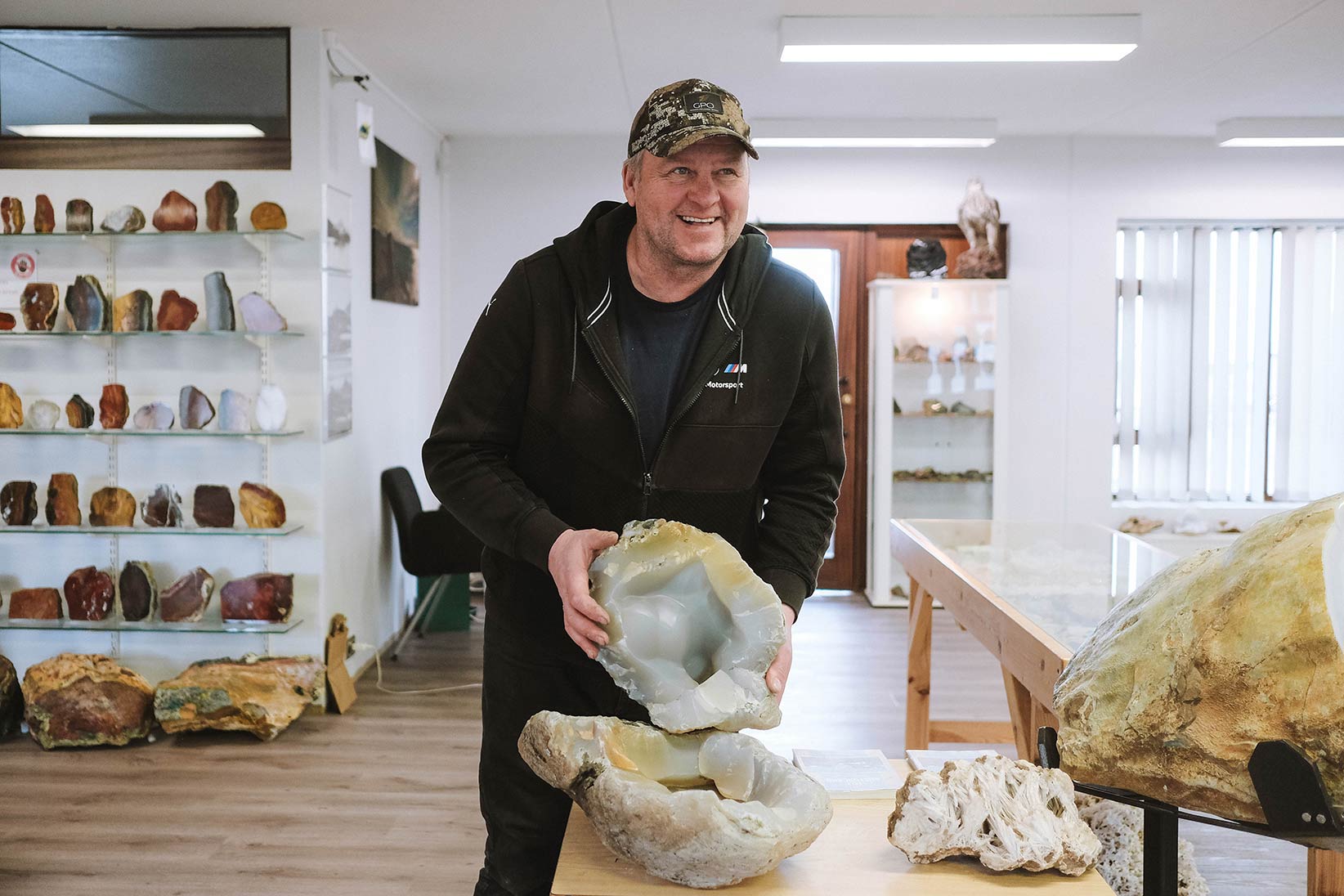
Auðunn´s Stone Collection in Djúpivogur. Photo: Michael Novotny
Audunn's Stone Collection is located at Markland 1 in Djúpivogur, in the old bank building, The stone collection is a true display of exceptionally beautiful stones. The diversity is great and the colour array unique. A large part of the stones have been cut open, polished, and polished again to bring out their inner structure and beauty, resulting in a unique interplay of colours, shine, and light refraction. The stones in the collection are placed on shelves, in cabinets, and on tables and stands. They are generally not labelled with species names, but Audunn has a good understanding of them, and his guidance is an important part of a visit to the collection.
Audunn Baldursson was born and raised in Djúpivogur and has collected stones for much of his life. Shortly after the turn of the last century, he bought his first stone saw and began to open the stones he found and reveal their inner structure and beauty. He has also polished stones and even has custom-made equipment for this purpose. Audunn finds the stones mainly in the vicinity of Djúpivogur, in the valleys and mountains, even high up in the mountainsides. He says many stones seem quite unremarkable at first glance as they lie on the ground. But he has an eye for details that hint that something more might be hidden inside them. He has spent a lot of time exploring stone trails, transporting the finds to the village with various means, and cutting and polishing the stones to showcase their splendour.
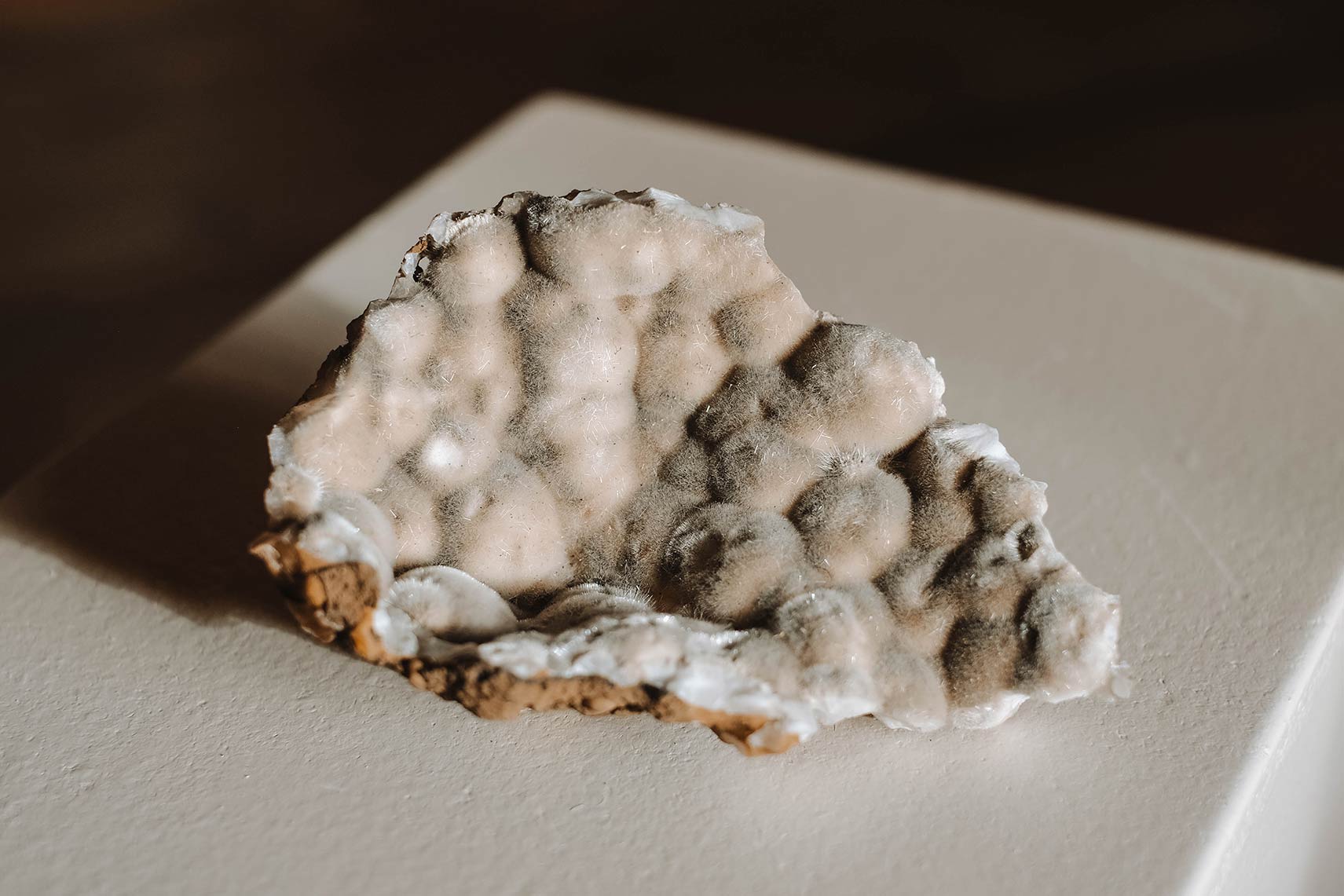
Stone collection in the Museum house in Neskaupstaður. Photo: Michael Novotny
This stone collection is part of the Neskaupstaður natural history museum and is located on the third floor of the museum house in Neskaupstaður. It is managed with advice from the East Iceland Nature Center. The stone collection is mainly in one room within a larger hall with other natural history artifacts, and next to the stone room, a model of a cave with magnificent stones in the walls has been built, which often interests children. The stone collection is diverse and systematically displays rock types and a large number of stone species, for example, most or all types of zeolites found in Iceland. In one cabinet, there are particularly splendid stones, many of which have been cut open and polished, but this part of the collection is not labelled with species names. The educational value of the collection is considerable, as the stone species are generally identified and labelled with species names and locations. There are also posters with various information and knowledge about rocks and different stone species. There is also an interesting model of a typical East Icelandic rock layer stack with different rock types and zones of cavity fillings.
The stone collection is largely derived from enthusiastic stone collectors who donated their collections for display. These men share the trait of being self-taught mineralogists and naturalists who have created remarkable stone collections with interest and diligence.
In addition to stones, the natural history museum in Neskaupstaður displays birds, mammals, bird eggs, marine life, and insects. Part of the collection is arranged in artificial landscapes resembling the natural habitats of the respective mammals and birds.
The museum is housed in a beautiful 100-year-old building in the centre of Neskaupstaður, along with the collection of painter Tryggvi Ólafsson and the maritime and blacksmith museum of Jósafat Hinriksson. The building was constructed in 1922 by the United Icelandic Stores and was the largest building in the Nes village at the time. Initially, the building was used for fish processing and as a warehouse, as a baiting facility, and for salted fish processing. A net-making operation was housed in the building for about two decades, and the herring industry also used the building for storage and repairs. The building became a museum in 2007.